


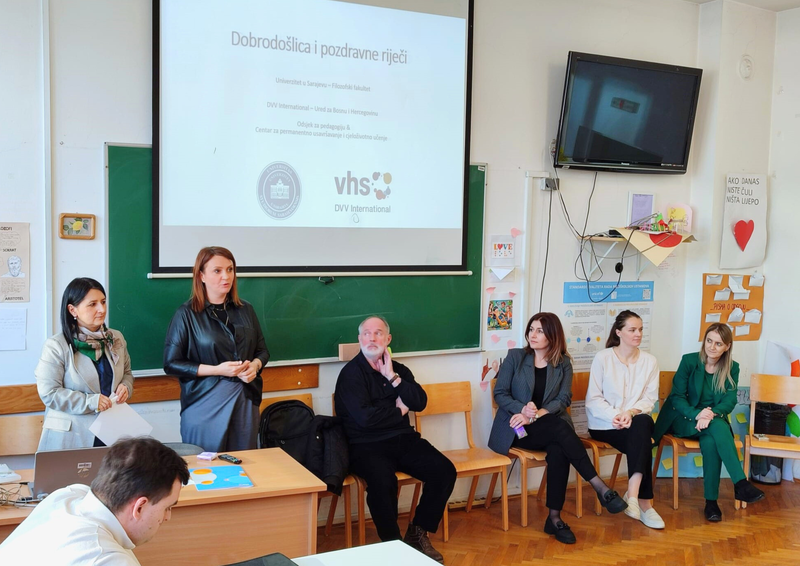
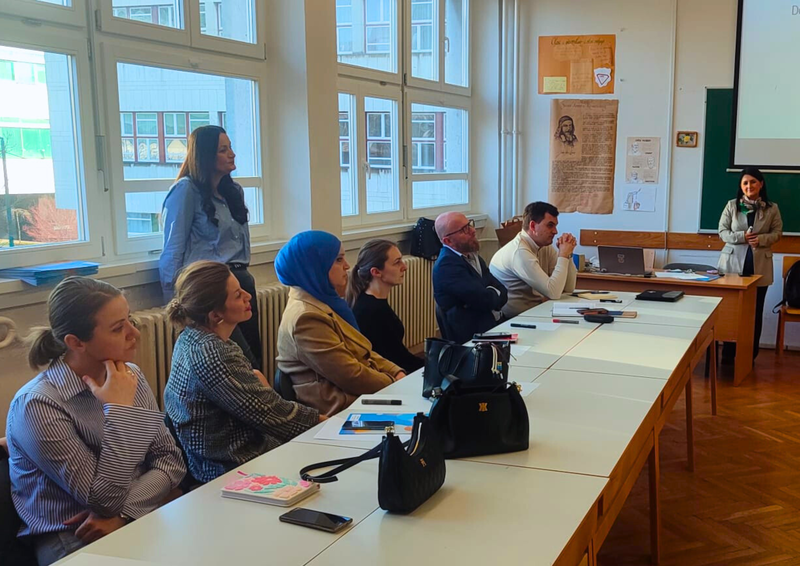
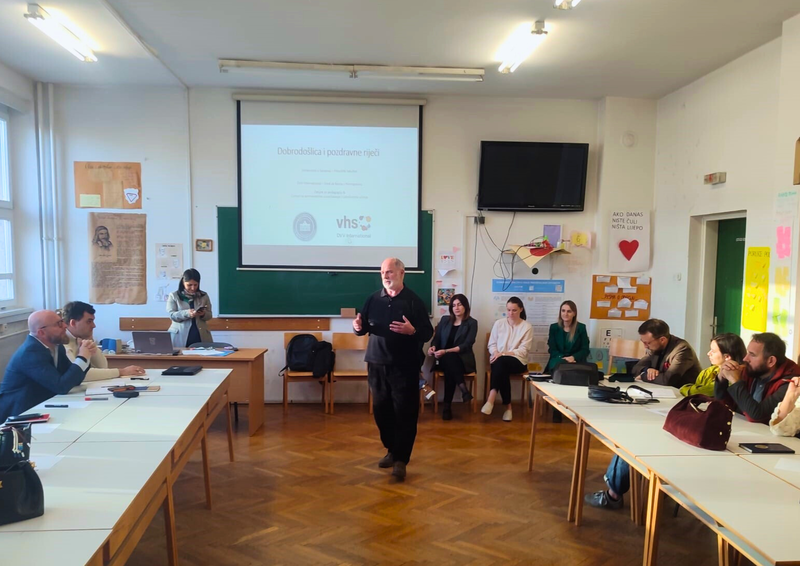
Yesterday, the Department of Pedagogy at the Faculty of Philosophy, University of Sarajevo, launched the implementation of the Basic Adult Education Training , university-developed lifelong learning program designed to equip participants with fundamental andragogic competencies for working in adult education. The program was developed in accordance with the regulations of the University of Sarajevo, with the support of DVV International – Country Office Bosnia and Herzegovina.
The training was created in response to the growing need for qualified professionals in the field of adult education. Its purpose is to enable participants to acquire essential andragogic competencies—knowledge and skills required for planning, delivering, and evaluating the teaching process with adult learners, while taking into account their specific needs, experiences, and learning styles.
It is intended for educators entering adult education for the first time, professionals from various fields who wish to advance their competencies, as well as anyone interested in gaining an introduction to the fundamentals of andragogy.
The Basic Adult Education Training program is structured on the Curriculum GlobALE framework. It is also aligned with contemporary education policies and the recommendations of UNESCO, the CONFINTEA VII process, and key European strategic documents, ensuring its relevance and compatibility within an international context. The focus of the training is on understanding the specific nature of adult learning, planning and implementing the teaching process, and applying reflective practice in professional work.
The program consists of five modules delivered over the course of one semester, comprising a total of 120 hours of contact instruction and an additional 120 hours of independent practical work, documented through an Andragogic Portfolio. The modules cover essential areas of andragogy: the role of adult education in local and global contexts; specifics of learning in adulthood; communication–interaction approaches to working with adult learners; planning and evaluation of the andragogic cycle; and practical implementation of a teaching unit. The structure of the program enables a gradual acquisition of knowledge and development of competencies—from theoretical foundations to practical application in real educational settings.
Upon completion of the training, participants receive a certificate confirming the acquisition of fundamental andragogic competencies, along with 15 accredited ECTS credits.
We would like to extend special thanks to the program coordinator, Assist. Prof. Amina Isanović Hadžiomerović, PhD, and her colleagues, whose expertise, dedication, and commitment made it possible to develop and implement this training. Their work guarantees the quality and professionalism that participants can expect in the coming months.
We wish all participants much success, inspiration, and motivation throughout the training, and hope that the knowledge and skills gained will be transferred to their institutions and communities.