


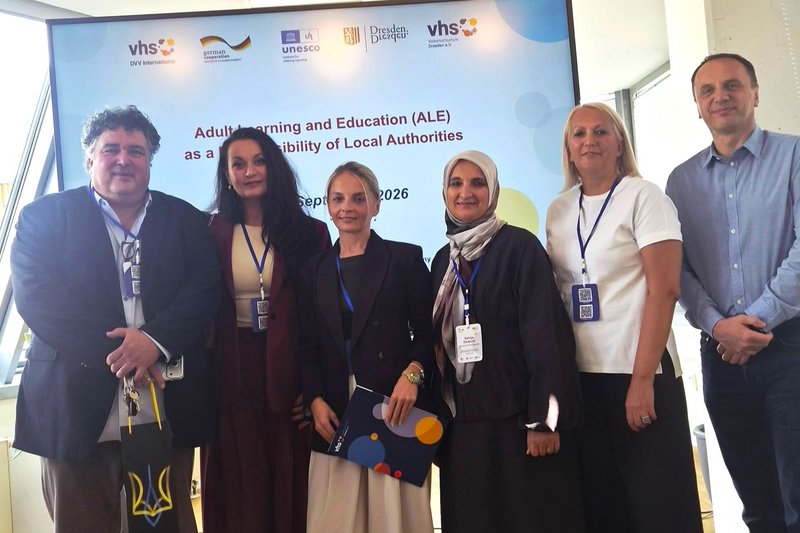
Last week, Dresden hosted the international conference “Adult Learning and Education (ALE) as a Responsibility of Local Authorities”, bringing together representatives of local authorities, civil society organisations, educational institutions, academia, and international organisations from Bosnia and Herzegovina, Armenia, Georgia, Kosovo, Moldova, Ukraine, Germany, Poland, France, the Republic of Korea, and the United Kingdom.
The conference, jointly organised by DVV International, the UNESCO Institute for Lifelong Learning (UIL), the City of Dresden, and Volkshochschule Dresden, focused on the role of local authorities in the development of adult learning and education and lifelong learning, as well as their responsibility in creating learning opportunities accessible to all citizens.
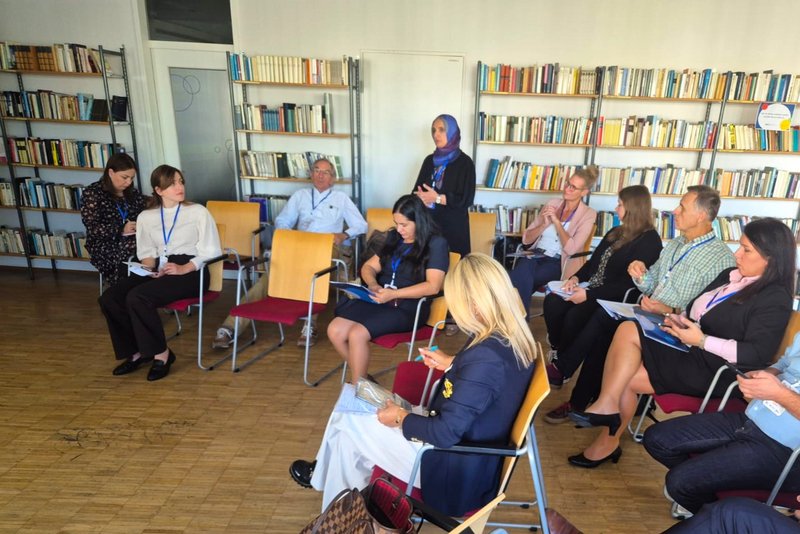
Through presentations, expert discussions, and the exchange of experiences, participants explored models of cooperation between local governments and adult education providers, the concept of learning cities, the contribution of adult learning and education to social cohesion and sustainable community development, and ways in which local stakeholders can jointly create better opportunities for lifelong learning.
The delegation from Bosnia and Herzegovina consisted of Dženita Džano (DVV International – Country Office Bosnia and Herzegovina), Enisa Mešetović (Municipality of Ilijaš), Sanela Dževlan (Sarajevo Regional Development Agency SERDA), Sehija Dedović (CEI Nahla), and Prof. Dr. Almir Peštek (School of Economics and Business, University of Sarajevo).
Throughout the conference, numerous examples of good practice were presented, demonstrating how cooperation among local authorities, adult education providers, and other stakeholders can contribute to community empowerment, improved employability, and the creation of new lifelong learning opportunities.
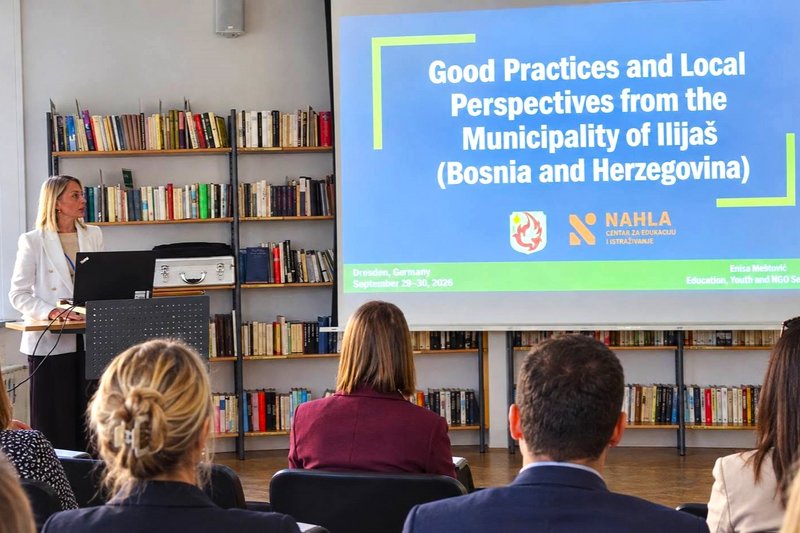
One of the most notable contributions from the Bosnia and Herzegovina delegation was the presentation delivered by Enisa Mešetović, representative of the Municipality of Ilijaš. Through her presentation entitled “Strengthening Communities through Adult Learning and Education: Good Practices from Ilijaš Municipality and CEI Nahla (Bosnia and Herzegovina)”, she showcased the successful cooperation between the Municipality of Ilijaš and CEI Nahla in the field of adult education.
Through their joint project, the Municipality of Ilijaš and CEI Nahla offer a wide range of free courses for young women aged 18 to 38, including Excel, accounting, business English, digital skills, social media management, and graphic design in Canva, complemented by group career counselling and job-search training. This example demonstrates how local authorities and adult education providers can directly contribute to community empowerment and the creation of new opportunities for citizens.
Speaking about the importance of the conference, Ms. Mešetović stated:
“I am grateful for the opportunity to place the experience of our local community in an international context, while also bringing back new knowledge, partnerships, and perspectives from Dresden.”
Reflecting on the significance of Bosnia and Herzegovina’s participation in the conference, Dženita Džano, Director of DVV International – Country Office Bosnia and Herzegovina, emphasised:
“I am proud that the delegation of Bosnia and Herzegovina had the opportunity to present our experiences and good practices at this conference. It is particularly important to me that the work of local communities, such as the Municipality of Ilijaš and our partners from CEI Nahla, is recognised internationally as an example of how adult education can empower citizens and contribute to community development. The participation of the Bosnia and Herzegovina delegation demonstrates that we are an active and relevant partner in European and global processes aimed at strengthening adult education.”
The conference once again confirmed that local authorities are key partners in the development of adult learning and education and that cross-sector cooperation is one of the most important prerequisites for building communities that promote lifelong learning. The exchange of experiences and good practices from different countries provided participants with new ideas and perspectives for further improving adult education policies and programmes at the local level.
Finally, we would like to express our sincere gratitude to the organisers of the conference, especially the DVV International Continental Exchange Project, as well as to the UNESCO Institute for Lifelong Learning (UIL), the City of Dresden, and Volkshochschule Dresden, for their hospitality, excellent organisation, and the opportunity to learn from one another through an international exchange of experiences and good practices.